


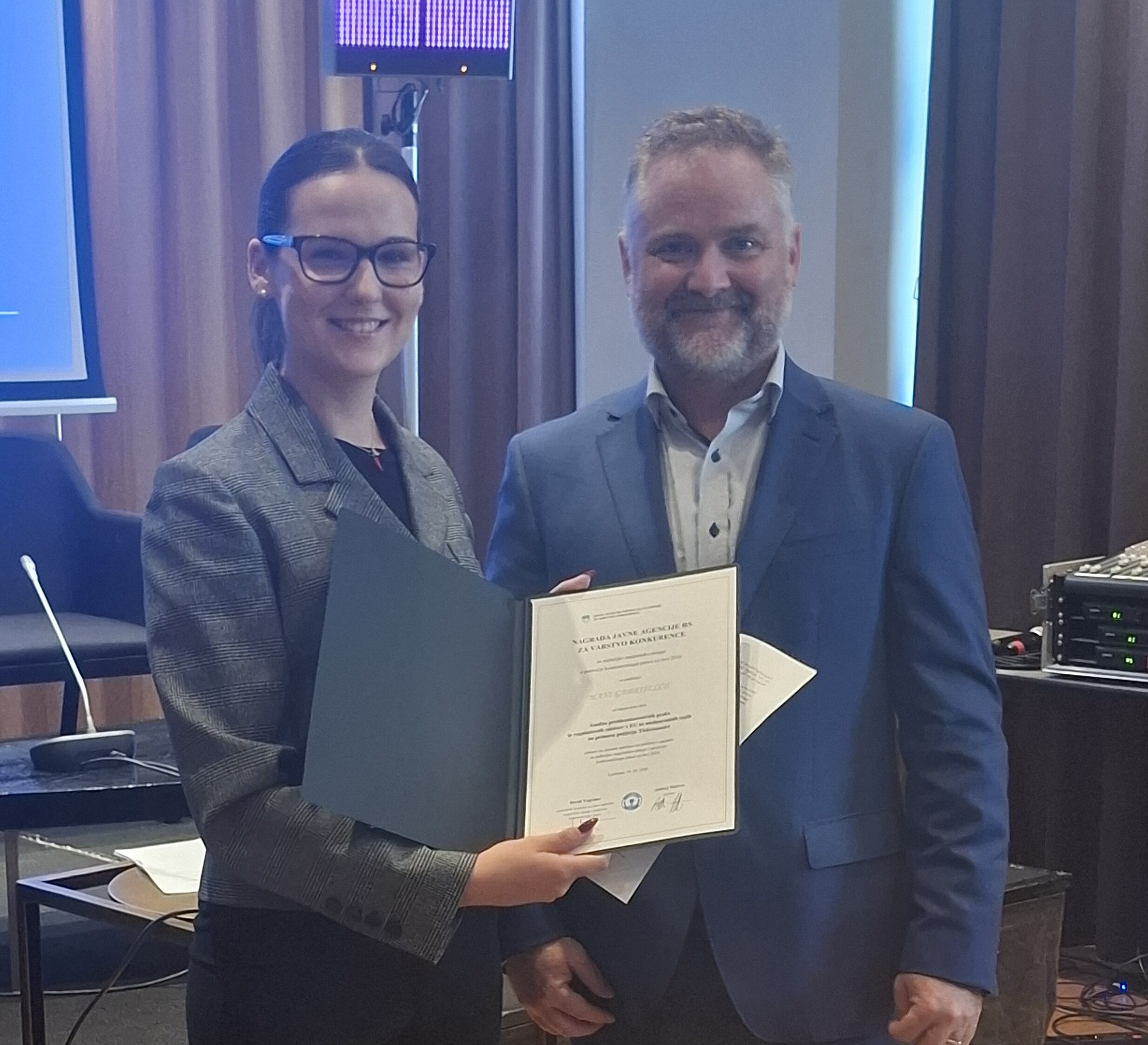



On October 14, Slovenian Competition Protection Agency (SCPA) hosted "Slovenian Competition Day 2026." The event was opened by Andrej Matvoz, Director of SCPA, who emphasized that competition protection does not operate solely within national borders; the challenges faced are similar across countries, regardless of their size. A well-functioning, competitive market benefits companies and the economy as a whole, while also offering advantages to consumers, Matvoz noted. He added that while the independence of competition authorities is a prerequisite, it does not imply an absence of accountability. The head of SCPA then presented the inaugural SCPA's Award for the best master’s thesis in the field of competition law to Hana Gabrijelčič. The award recipient subsequently presented her thesis, titled "An Analysis of Anti-Competitive Practices and Regulatory Responses in the EU and International Markets: The Case of the American Company Ticketmaster."
After 2003, the transposition of competition rules to the national level
The keynote speaker at this year’s SCPA's conference, Ian Forrester, reflected on the early days of his work in competition law - a field pioneered by EU institutions in Brussels - recalling a time when the number of resolved cases could be counted on the fingers of one or two hands. Forrester noted that by the time Slovenia joined the EU, competition law was already quite well-developed at the EU level, though, unfortunately, this was not yet the case in most individual EU member states. The 2003 reform brought an end to the European Commission’s monopoly in this area, shifting the application of competition rules to the national level.
"Competition law in Europe has come a long way over the last fifty years or so. It has served the political objectives of the Community through enforcement priorities that have evolved significantly—covering issues such as parallel trade, the licensing of intellectual property rights, market integration, and tech giants. While the intensity of judicial oversight has varied, it is becoming increasingly predictable. In my view, the answer to these concerns is simple: any new legislation brings with it both successes and shortcomings, as well as unintended consequences. European competition law is no longer the exclusive domain of an initiated few. It is no longer accessible only to a lucky handful - those with access to top-tier legal counsel and judges who truly care about the case - but is now within reach of the merchant, the footballer, the video gamer, and the homemaker. And that is something we can be proud of," stated Ian Forrester, among other remarks.
On corrective measures and unfair trading practices
Two round tables followed. The first, moderated by Zombor Berezvai - former Chief Economist and Head of the Economic and Market Research Department at the Hungarian Competition Authority - focused on remedial measures in the context of corporate concentrations, with participants citing specific examples. In addition to representatives from the Slovak (Juraj Beňa), Czech (Kamil Nejezchleb), and Slovenian (Neža Zupančič) competition authorities, perspectives were also shared by José Fernando Sánchez Carrillo, a representative of the European Commission’s Directorate-General for Competition, and attorney Matej Črnilec. The second round table, moderated by attorney Eva Škufca, addressed the effectiveness of the implementation of the Directive on Unfair Trading Practices. Participants included: Georg Seper, representing the Austrian department responsible for enforcing fair competition legislation; Dr. Mirta Kapural, President of the Croatian Competition Agency; Branko Ravnik, the Ombudsman for the Food Supply Chain; Dr. Jože Podgoršek, President of the Chamber of Agriculture and Forestry of Slovenia; Martin Gosenca, Acting Head of the Analysis Department at the Ministry of Agriculture; and Antigoni-Aikaterini Tsakona, a representative of the European Commission’s Directorate-General for Agriculture and Rural Development.